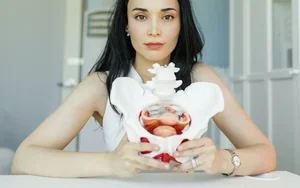
From the Renova Weekly Live Q&A with Nasim Delfaninejad, MScPT, licensed pelvic health physiotherapist
Every week, Renova members send their questions to Nasim, and she answers them in a live Q&A. This week's questions all came back to one theme: the small habits during the day that can quietly add tension to the pelvic floor.
Below are the questions members asked, with Nasim's answers. Each question has been rewritten without names or personal details.
Key Takeaways
Pee every 2 to 3 hours. Holding it for long stretches keeps your pelvic floor working.
Drink about 2.5 litres of water a day, and don't go to the washroom when you don't need to.
Never push or strain to pee. Relax, use a footstool and gently move your pelvis instead.
Sit fully on the toilet. Hovering keeps your pelvic floor engaged when it should be letting go.
Stopping your pee midstream is not a useful pelvic floor test and disrupts a natural reflex.
Holding your stomach in all day pushes pressure down onto your pelvic floor.
Body scanning and diaphragmatic breathing help you catch and release tension during the day.
Is It Bad to Hold Your Pee?
Yes, if you hold it for long stretches. A normal pattern is to pee every 2 to 4 hours, and every 2 to 3 hours is closer to ideal.
When you hold urine for longer, your pelvic floor muscles stay tense to keep it in. That adds to the very tension you are working to calm.
How Much Water Should You Drink for Pelvic Floor Health?
Aim for about 2.5 litres through the day, unless your doctor has given you a different target. Hydration supports your bladder and urinary tract, as well as your muscles, nerves, and every cell in your body.
When you are well hydrated, your bladder communicates clearly and lets you know when it's time to go. If you don't need to go, don't force yourself.
Should You Push to Pee Faster?
No. Pushing or straining to empty your bladder has a rebound effect that creates more tension in your pelvic floor. On the toilet, your only job is to let go and relax. Your bladder does the rest.
If your stream is slow to start, try this instead:
Use a footstool. Any stool that lifts your knees slightly above your hips works. It doesn't need to be a branded one.
Open your knees and lean forward. This brings you close to a squat, which relaxes your pelvic floor more easily.
Move your pelvis gently. Rock side to side, forward and back, or in small circles. Nasim calls it dancing on the toilet. The movement uses the pressure above your pelvis to help urine flow without forcing it.
Is Hovering Over the Toilet Bad for Your Pelvic Floor?
Yes. In female anatomy, the more fully seated you are, the closer you are to a squat, and the more your pelvic floor relaxes. Hovering keeps those muscles engaged, which makes it more likely you will push to empty.
If a public toilet makes you uneasy, line the seat with toilet paper. As long as the seat isn't cracked or broken and the surface looks clean, it is fine to sit down and relax. You can always shower or change your clothes when you get home.
Should You Stop Your Pee Midstream to Test Your Pelvic Floor?
No. You may hear this advice, sometimes even from specialists, but it tells you nothing useful about your pelvic floor control.
When you pee, your bladder muscle contracts to push urine out while your pelvic floor relaxes and lengthens, especially around the urethra, the tube that carries urine out of the body. The two work in opposite directions. Stopping the stream interrupts the natural communication between your bladder, your brain and your pelvic floor. On the toilet, just relax and let go.
Can Holding Your Stomach In Cause Pelvic Floor Tension?
It can. Tensing your core all day to keep your stomach looking flatter pushes pressure down toward your pelvic floor and up toward your diaphragm.
Your deep core works as one system, and the pressure inside your abdomen needs to stay balanced. Nobody has a flat stomach all day: it naturally changes after meals and with bowel movements. Save core engagement for exercise and let your belly soften the rest of the time.
How Can You Relax Your Pelvic Floor During the Day?
Start with awareness. Two tools help most:
Body scanning. Check in from your head down to your feet and release tension as you go. Renova members learn a guided body scan in Module 4 of the Pleasure Path course.
Diaphragmatic breathing. Practise it sitting and standing, not only lying down. When you catch yourself clenching, let your pelvic floor soften with your breath.
The more you practise, the more often you will notice yourself tensing. That is a good sign. Awareness is the first step to change.
Why Removing Bad Habits Comes First
Removing the habits that work against your pelvic floor often makes a bigger difference than adding new healthy ones. If they continue, you can end up taking a few steps forward and then a few steps back.
Check in with yourself this week. Pick the habit you notice most and change it gradually.