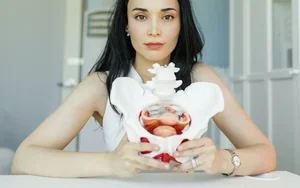
Every week, Renova members send their questions to Nasim, and she answers them in a live Q&A inside the community. This week, the same question arrived in the community and by email: what is the best tool to start with for vulvodynia? Should you begin with a pelvic wand, vaginal dilators, Kiwi or a mix of all three? Nasim hears this often from patients in her clinic too, so she gave the whole session to it.
Questions have been rewritten without names or personal details. This is general education, not medical advice.
Key Takeaways
There is no single best tool for vulvodynia. The right one depends on where your pain is, what you want to be able to do and how insertion feels.
If insertion brings pain, burning, tightness or anxiety, vaginal dilators help your nervous system feel safe with insertion, one step at a time.
Work up to the dilator size closest to your goal, not automatically to the largest size.
If insertion is comfortable but your muscles still feel tight, you can start with a pelvic wand. Kiwi works on the outside only.
Tools work best alongside whole-body mobility, muscle activation, breathing, daily habits and plenty of time.
What Is the Best Starting Tool for Vulvodynia?
There isn't one tool that suits everyone. Before choosing between a pelvic wand, vaginal dilators or Kiwi, ask yourself three questions: where exactly is the pain, what do you want to be able to do, and how does insertion feel right now? Your answers point to the right tool, and often to a combination.
Vulvodynia is pain, burning, discomfort or a feeling of rawness in the vulva that lasts at least three months without a clear cause. It is a diagnosis made by a practitioner once other causes have been ruled out. You can read more in our guide to vulvodynia.
Why Does It Matter Where My Vulvodynia Pain Is?
Because vulvodynia is an umbrella term. Pain around the clitoris is called clitorodynia. Pain at the vestibule, the entrance of the vagina, is called vestibulodynia, which we cover in our guide to provoked vestibulodynia. Pain spread across the vulva is generalized vulvodynia.
Knowing where you feel it most tells you which muscles and tissues need the most attention. Even without a diagnosis, you can usually get a sense of where the pain is severest.
When Should I Start With Vaginal Dilators?
When insertion itself is the problem. Vulvodynia often builds tension across the whole pelvic floor, around the entrance and in the deeper muscles too. If you feel pain, tightness, restriction, burning or irritation when something is inserted, or you feel hesitant and anxious about it, dilators are the place to start.
Gradual insertion helps your nervous system become more comfortable and feel safe again. Over time, fear and pain give way to calm, comfort, control and even pleasure. If you are still choosing a set, Nasim's Q&A on choosing dilators, wands and Kiwi covers covers materials, shapes and what to look for.
What Dilator Size Should I Work Up To?
The size closest to your goal. You don't need to reach the largest dilator unless your goal calls for it.
Tampons: work up to about the size of a tampon.
Menstrual disc or cup: fold it the way you would to insert it, and work up to that diameter.
Medical exams: for an internal ultrasound or a speculum exam, work up to the middle sizes. Nasim explains how to prepare in her Q&A on transvaginal ultrasound with vaginismus.
Intercourse: work up to the larger sizes.
When Can I Start With a Pelvic Wand Instead?
When insertion is comfortable, but tension isn't. If you can insert without much restriction, tightness or anxiety, yet your pelvic floor still feels tight overall, you don't need to work through gradual exposure first. You can use a pelvic wand right away.
A wand also reaches beyond the pelvic floor. You can use it on your lower abdominal wall, your inner thigh muscles or anywhere else you feel tension, pain or discomfort.
Is Kiwi or a Pelvic Wand Better for Vulvodynia?
It depends on whether you need to work inside. Both are good for external releases. Kiwi's insertable tip is short, though, so it can't reach the deeper muscles of the pelvic floor, where tension often builds with vulvodynia pain.
If you want one tool for both external and internal release, the pelvic wand is the only one of the three that does both.
What Should I Focus On If My Pain Is Near the Clitoris?
Spend more time on the outside. With clitorodynia, focus on external pelvic floor releases and fascial mobility: the tissue from your belly button down to your pubic bone, the outer layer of the pelvic floor and the muscles along the arch of the pelvis beside the clitoris. A wand or Kiwi both work well here.
What Should I Focus On If My Pain Is at the Vaginal Entrance?
Start low and on the outside. With vestibulodynia, focus on the lower part of the pelvic floor and work externally first, the same way the external pelvic floor release is taught in the Pleasure Path course. Give desensitization plenty of time before moving on. Vibration can help here too, as a gentle way to desensitize the area.
Is Vulvodynia Only About the Pelvic Floor?
No. Muscle imbalance and tight fascia anywhere from the waist down can change how the vulva and vagina feel. That includes your glutes, hamstrings, inner thighs, calves, foot mobility and the fascia of your abdominal wall. A wand or Kiwi can help you release tension in all of these areas.
Releasing is only half of it. Muscles that are often underactive, such as the hip abductors and external rotators, need activation too. Combining release, stretching and activation with your tools gives you the most benefit.
You can even add gentle movement while using a tool. Let your knees fall slowly out to the side and back, or straighten one knee and bend it again, so your body gets a sense of movement and ease.
What Else Helps Vulvodynia Between Tool Sessions?
Your tools aren't only the wand, Kiwi or dilators. Small habits through the day take stress off your system without focusing on the pelvic region:
Check your posture and alignment.
Do a quick body scan a few times a day.
Avoid staying in one position for too long.
Practise diaphragmatic breathing.
Sit on a rolled towel or a small ball under the perineum.
Nasim's Q&A on habits that build pelvic floor tension looks at more of the everyday patterns that keep these muscles tight.
Why Does Calming My Nervous System Help Vulvodynia Pain?
Because your brain is one of the main organs you are working with. Your pain is absolutely real. The area sends signals, and your brain and nervous system produce the sensation of pain. When an area hurts, the brain keeps its attention locked on it.
The goal is to gently bring your nervous system's attention back to your whole body in the present moment. That lets the area relax and let go, so the pain signals can settle and slowly turn down. Every strategy in this post, used gradually, helps your nervous system feel safe and regain control. Nasim explains this further in her Q&A on neuroplasticity and the nervous system.
Should I Follow a Vulvodynia Diet or Take Supplements?
Be careful with what you find online. There are many diets, restrictions, techniques and supplements recommended for vulvodynia, and some of them do more harm than good. Nasim has invited Renova members to send their questions on diet and supplements so she can review the research and share information based on evidence inside the community. Speak with your doctor before starting any supplement.
How Long Does It Take to See Progress With Vulvodynia?
Give it time, because time is your ally. There won't be a sudden shift or a morning when you wake up and everything is gone. As you work through your program and add mobility, exercises and gentle movement to your routine, your body slowly begins to change.
Your endurance builds, you can do more, and your symptoms gradually ease. Try not to rush the process.